Introduction
Good lighting can make a noticeable difference in photographs, videos, online meetings, and other forms of digital communication. Even a relatively simple recording setup can produce more consistent results when the subject is clearly illuminated. However, achieving suitable lighting at home is not always straightforward. Ceiling lights may create shadows, windows can produce uneven brightness, and ordinary desk lamps may be difficult to position correctly.
A ring light is one option for addressing these challenges. It provides a circular light source that can be positioned around or near a smartphone camera, helping illuminate the subject from the front. Ring lights are commonly used for video calls, social media content, makeup tutorials, product demonstrations, and casual photography.
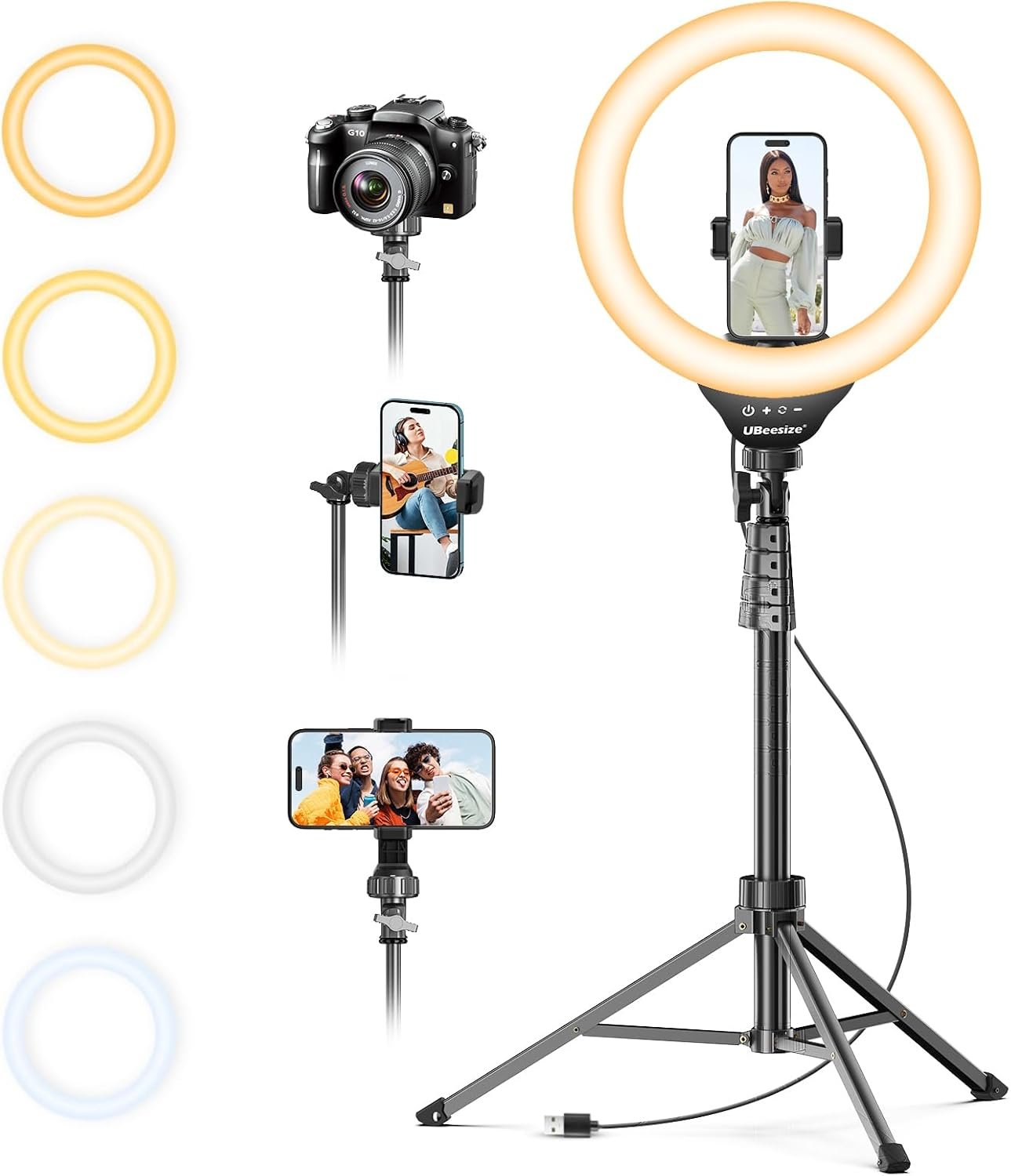
The UBeesize 12-inch LED Ring Light with a 62-inch tripod stand, phone holder, and remote is designed around this type of setup. Its combination of a ring-shaped LED light, adjustable support, smartphone mounting hardware, and remote control brings several basic recording accessories together in one package. Rather than requiring users to assemble a lighting arrangement from separate components, this type of kit provides a starting point for creating a dedicated space for filming or taking pictures.
Understanding the equipment’s features is important before deciding whether it fits a particular workspace or recording routine. The size of the light, the height of the stand, the position of the phone, and the way brightness is adjusted can all influence how comfortably the setup works in everyday situations.
This guide explains the general functions of the UBeesize 12-inch ring light kit, how it can be incorporated into different activities, who may find this type of equipment useful, and which practical considerations deserve attention before choosing it.
Key Features of the UBeesize 12-Inch LED Ring Light
1. A 12-Inch Circular Light Source
The central component is a 12-inch LED ring light. Its circular shape allows the light to surround the area where a compatible phone camera can be positioned, creating a forward-facing lighting arrangement.
The size of a light source influences how it illuminates a subject. Compared with a small point light, a larger source positioned relatively close to a person can produce softer-looking shadows. The result depends on the distance between the light and the subject, the surrounding environment, and the camera’s exposure settings.
For example, someone recording a talking-head video at a desk may position the ring light just behind or around the smartphone. This arrangement can illuminate the face more evenly than relying entirely on a ceiling fixture positioned overhead.
A 12-inch light is also a practical middle ground for many personal recording spaces. It is larger than a compact clip-on light but generally less cumbersome than a large studio softbox. Nevertheless, its illumination area remains limited compared with professional lighting equipment intended for larger rooms or group recordings.
The light is only one part of the setup. Its placement and distance from the subject can have as much influence on the final appearance as the size of the ring itself.
2. LED Lighting for Everyday Recording
LED lighting is widely used in compact recording accessories because it can provide illumination without requiring the type of bulky equipment associated with traditional studio lamps.
For everyday content creation, an LED ring light can help reduce dependence on changing natural light. Someone who records short videos in the evening, for example, may prefer having a dedicated light source rather than relying on daylight that is no longer available.
The actual lighting result depends on several factors, including the light’s output, its selected brightness level, the distance to the subject, and the ambient light already present in the room.
It is also worth remembering that brighter lighting is not automatically better. Excessive illumination can wash out skin tones, create unwanted reflections on glasses, or make reflective products appear overly bright. Adjusting the light’s position and output can help maintain a more balanced image.
Users should consult the product’s current specifications and included instructions for details about its lighting modes, power requirements, and adjustment controls.
3. A Tripod Stand Extending to 62 Inches
The kit includes a tripod stand advertised as extending to 62 inches. An adjustable stand allows the light and phone holder to be positioned at different heights, making it easier to adapt the arrangement to different recording activities.
A lower position may work well for seated video calls or desk-based demonstrations. A taller position can be more convenient for standing presentations, full-body framing, or recordings in which the camera needs to sit above a table.
The ability to change height also helps users experiment with camera angles. Positioning the phone near eye level is often a useful starting point for conversational videos because it produces a more natural perspective than placing the camera far below the subject’s face.
However, the advertised maximum height does not mean every recording should use the tallest setting. A fully extended tripod can be more sensitive to bumps, uneven floors, and accidental contact. Its stability also depends on how the legs are spread, the weight distribution, and the surface underneath it.
Before recording, users should ensure the tripod is standing securely and that the light and phone are properly attached. Keeping cables away from walking paths can further reduce the chance of pulling the setup over.
4. A Smartphone Holder
The included phone holder is intended to support a compatible smartphone while it is being used with the ring light. This combination allows users to keep the camera and light in approximately the same recording area.
A dedicated holder can be useful when filming without another person to operate the camera. Once the phone is positioned and the recording settings have been selected, the user can speak, demonstrate a product, or perform another activity while the smartphone remains in place.
Phone compatibility is an important consideration. Smartphone dimensions, case thickness, and the holder’s mounting design can affect whether a particular device fits securely. Users should check the supported phone dimensions and the instructions supplied with the kit rather than assuming every phone will fit.
It is also useful to confirm that the holder allows the camera to remain unobstructed. Some recording activities work better with the phone in portrait orientation, while others benefit from landscape framing. The holder’s adjustment range determines how conveniently these positions can be achieved.
A secure mount is particularly important when the tripod is extended or the phone is relatively heavy. Users should verify that the phone is firmly held before moving away from the setup.
5. Remote Control for Convenient Operation
The product listing identifies a remote as part of the kit. Remote controls can make a smartphone recording arrangement more convenient by reducing the need to touch the phone during certain operations.
For instance, someone filming a short presentation may position the phone on the tripod, move into the recording area, and use a compatible remote function to start capturing content. This can be helpful when recording alone or when the phone is positioned slightly beyond comfortable reach.
The precise functions depend on the supplied remote and the phone being used. Some remotes operate a compatible camera shutter, while other controls may support additional functions. Users should check the manufacturer’s instructions to determine what the included remote can do with their particular smartphone and camera application.
Compatibility should not be assumed across every device or application. Bluetooth pairing, operating-system behavior, and camera software can affect remote operation.
A remote is a convenience rather than a substitute for checking the recording itself. Before an important session, users should confirm that the camera is capturing video or photos correctly, the framing is appropriate, and the audio is working as expected.
6. A Combined Lighting and Recording Arrangement
One practical advantage of a kit containing a light, tripod, phone holder, and remote is that these components can be organized around a single purpose.
A beginner setting up a small filming area may otherwise need to identify a compatible phone mount, a suitable stand, and a separate lighting accessory. A bundled arrangement can simplify that initial process, provided the included components meet the user’s requirements.
This does not eliminate every setup decision. Users still need to consider the location of power outlets, the recording space, phone compatibility, and whether the equipment can be stored comfortably when it is not in use.
The kit is best understood as a foundation for a basic smartphone recording setup rather than a complete professional studio. Audio recording, background control, editing, and room acoustics may require separate attention depending on the intended project.
How the UBeesize Ring Light Can Be Used
Creating Social Media Videos
Short-form video has become a common format for sharing tutorials, demonstrations, personal updates, and educational material. A ring light and smartphone tripod can help creators maintain a consistent camera position while recording these clips.
For example, a creator making a series of short educational videos can mark a regular tripod position on the floor or desk, place the phone at a consistent height, and keep the light at a similar distance between sessions.
This repeatable arrangement can reduce the amount of time spent preparing each recording. It also makes it easier to compare footage from different days and maintain a recognizable visual style.
Lighting should complement the subject rather than dominate the scene. A creator can begin with a moderate light setting, review the phone’s preview, and adjust the angle or brightness as needed.
Background clutter, camera placement, and audio quality remain important. A ring light may improve visibility, but it cannot independently correct a noisy room, distracting background, or poorly framed shot.
Recording Makeup and Skincare Tutorials
Makeup demonstrations often benefit from lighting that makes facial details visible. A ring light can illuminate the face from a forward-facing position, helping viewers see how a product is applied and how different shades appear under the recording conditions.
The setup may also be useful for skincare routines, hair styling, and other personal-care demonstrations.
However, artificial lighting can change the apparent color of makeup and skincare products. A shade that appears accurate under one light source may look different in natural daylight or another room. For demonstrations involving color matching, it is helpful to compare the camera preview with the product under more than one lighting condition.
Reflections also deserve attention. Glasses, shiny packaging, and glossy cosmetic products can reflect the circular light source. Slightly changing the light’s height or angle may reduce unwanted glare.
The most useful arrangement is one that provides adequate visibility without making the subject look unnaturally bright.
Supporting Video Calls and Online Meetings
A dedicated ring light can be useful for people who regularly attend remote meetings, online classes, consultations, or virtual interviews.
A room’s normal lighting may be uneven, especially when a window is behind the person on camera. In that situation, the face can appear darker because the camera is exposed for the brighter background.
A forward-facing light can help balance the scene by illuminating the person from the front. Positioning the camera near eye level can also create a more comfortable viewing angle for colleagues or classmates.
The 62-inch stand offers flexibility for users who want the phone positioned above a desk or at a standing presentation height. Whether the maximum height is appropriate depends on the furniture arrangement and the individual’s camera framing requirements.
For computer-based meetings, a smartphone ring light may not be the most convenient option if the user relies on a webcam. It may still provide useful illumination, but the phone holder is primarily relevant when a smartphone is serving as the camera.
Photographing Small Products
Small-business owners, online sellers, and hobbyists often need clear photographs of products for catalogs, listings, or social media posts.
A ring light can provide frontal illumination for objects such as accessories, stationery, craft items, and small household products. A tripod helps maintain a consistent camera position, which is useful when photographing multiple items in the same session.
For product photography, the relationship between the light and the object matters. Shiny surfaces may reflect the ring’s circular shape, while transparent items can require more careful positioning. Moving the light slightly to one side or introducing a suitable diffuser, when appropriate, may improve the appearance of the image.
A ring light is not a replacement for every type of product lighting. Larger products may require a broader light source, and products with intricate textures may benefit from lighting from the side to reveal their shape.
For small objects, users should also check the minimum focusing distance of their smartphone camera. Moving the phone too close can result in soft focus, regardless of how well the scene is illuminated.
Recording Educational Content
Teachers, tutors, coaches, and independent educators can use a smartphone tripod and light to create lessons, demonstrations, and instructional videos.
A fixed camera position is particularly useful for content that includes spoken explanations or demonstrations performed at a desk. The creator can prepare the equipment once and then focus on explaining the subject.
For a lesson involving books, tools, or handwritten notes, the phone may need to be angled toward the work surface. The included holder’s adjustment capabilities determine how easily that position can be achieved.
A ring light can illuminate the workspace, although overhead or side lighting may be more appropriate when the subject is a flat page. The best arrangement depends on whether the video focuses primarily on the instructor, the demonstration, or both.
Creators should conduct a short test recording before preparing a complete lesson. This helps reveal shadows, focus problems, reflections, and framing issues while there is still time to adjust the setup.
Producing Livestreams
Livestreaming requires a recording arrangement that remains functional for the duration of a broadcast. A tripod can keep the smartphone in place while the light helps maintain more consistent illumination.
Possible uses include live discussions, informal demonstrations, product presentations, and interactive educational sessions.
Before beginning a stream, users should confirm that the phone has sufficient battery power, the internet connection is reliable, and the chosen application supports the intended orientation and camera settings.
Long sessions can introduce practical challenges. The phone may heat up, the lighting may require continuous power, and the equipment may occupy more space than expected. Cable management and ventilation should therefore be considered when planning a permanent streaming corner.
The ring light and stand support the physical recording arrangement, but they do not guarantee stream quality. Audio clarity, connection stability, presentation structure, and audience interaction remain separate considerations.
Improving a Home Recording Space
A dedicated recording corner can make content creation more organized. The ring light and tripod can be placed near a desk, against a plain background, or in another location where the phone has a clear view of the subject.
Some users may leave the equipment assembled between sessions. Others may prefer to fold or disassemble the stand and store it away to keep the room uncluttered.
Before choosing a permanent location, consider the stand’s footprint, the route of any power cable, the availability of a suitable background, and the amount of room needed to move around comfortably.
The light does not have to be positioned directly in front of the subject in every situation. Small changes in distance and angle can help control reflections and create a more natural appearance.
A consistent setup is often more useful than an elaborate one. Even a modest recording space can work well when the lighting, camera position, background, and sound are considered together.
Who May Find This Type of Ring Light Suitable?
Beginner Content Creators
People starting to make videos with a smartphone may appreciate having a light and stand available in one kit. It provides a straightforward way to experiment with camera angles and basic lighting without immediately investing in a complex studio arrangement.
Beginners can start with simple talking-head videos, then adjust the setup as they learn more about framing, exposure, and sound.
Social Media Creators
Creators who regularly publish short videos, tutorials, or personal updates may find the combination useful for maintaining a repeatable filming position.
The setup can be especially practical for individuals who record alone and need a stable place to mount their phone.
Remote Workers and Online Educators
People who frequently appear on video calls may benefit from having a dedicated source of front-facing illumination. Teachers and tutors may also appreciate the flexibility to adjust the stand for different demonstrations.
Users should still consider whether a smartphone-based setup matches the camera equipment they already use.
Makeup Enthusiasts and Personal-Care Creators
The circular light arrangement may help illuminate the face during makeup application or beauty-related recordings. It can also serve as a lighting source for informal photographs.
People who need precise color reproduction should test the light carefully, because artificial illumination and smartphone processing can affect how colors appear.
Small Businesses and Hobbyists
Individuals who photograph small items for online listings, craft projects, or social media may find a tripod and ring light useful for creating more consistent images.
Those who photograph large products, highly reflective objects, or professional commercial work may need additional lighting equipment and a more specialized setup.
Important Things to Consider Before Choosing a Ring Light Kit
Confirm the Included Accessories
Product bundles can change over time, and accessories may vary between listings or versions. Before making a decision, check the current product page to confirm that the 12-inch ring light, 62-inch tripod, phone holder, and remote are included in the configuration being considered.
Reviewing the listing’s specifications and photographs can help clarify what is supplied and whether additional accessories are needed.
Check Phone Compatibility
Not every smartphone fits every holder. Consider the phone’s dimensions, weight, case thickness, and the holder’s stated compatibility range.
Also check whether the phone can be positioned vertically and horizontally if both orientations are important to your work.
A secure fit is essential. The phone should remain stable when the holder is adjusted, and the camera lens should remain unobstructed.
Understand Lighting Limitations
A 12-inch ring light can be useful for a person sitting or standing relatively close to the camera. It is not necessarily suitable for illuminating an entire room or a large group.
The result also depends on ambient lighting. Strong sunlight, overhead fixtures, and light-colored walls can affect how the scene appears.
A ring light may help reduce some shadows, but it does not eliminate every shadow or guarantee professional-looking footage. Experimenting with the position, distance, and brightness is part of using any lighting accessory effectively.
Consider Tripod Stability
The maximum advertised height is only one part of tripod performance. The spread of the legs, the floor surface, the weight of the phone, and the position of the light all influence stability.
A stand placed on an uneven surface may wobble. An extended stand can also be easier to knock over accidentally.
Keep the tripod away from doorways and high-traffic areas, and avoid placing it where pets or children may pull on it. Check the mounting connections before every session.
Review the Power Requirements
LED lights require a suitable power source. Check the current listing and included documentation for the kit’s power connection, cable arrangement, and any requirements for a compatible USB power adapter.
Do not assume that every accessory in a bundle is powered in the same way. The light and remote may have different power requirements.
If the equipment will be used for extended livestreams, consider how the light will remain powered and how the phone will be charged without creating a cable hazard.
Consider Space and Storage
Although a ring light kit is more compact than many studio arrangements, the tripod still needs room for its legs and enough clearance to position the phone correctly.
Measure the available space if the equipment will be used in a small bedroom, shared workspace, or compact home office.
If the stand will be stored after each session, check the folded dimensions and the manufacturer’s guidance for adjusting or disassembling it.
Do Not Overlook Audio Quality
Lighting improves visibility, but viewers also need to hear the content clearly. A ring light kit does not necessarily include a dedicated microphone.
For spoken videos, consider room echo, background noise, microphone distance, and whether the smartphone’s built-in microphone is adequate for the intended recording.
A quiet room and careful microphone placement can improve the listening experience without requiring a complicated audio setup.
Consider the Type of Content You Produce
A ring light is not equally useful for every recording task. It is often convenient for close-up portraits and smartphone videos, while landscape photography, large product shoots, and multi-person recordings may call for different lighting arrangements.
Think about the typical distance between the camera and the subject, the size of the recording area, and whether the light needs to illuminate anything beyond the person in front of the phone.
Choosing equipment around the actual task is more practical than assuming that one lighting arrangement will suit every situation.
Comparing General Categories of Lighting Equipment
Ring lights are one of several common lighting options available to smartphone creators. Understanding how they differ can help users decide which arrangement fits their work.
Ring Lights
Ring lights provide a circular source of light that is often positioned close to the camera. This arrangement is convenient for portraits, makeup demonstrations, video calls, and direct-to-camera presentations.
A kit combining a ring light with a tripod and phone holder can simplify the process of setting up a basic smartphone recording area.
The main limitation is that the light’s size and position may not suit every subject. Larger scenes or reflective objects may require a different lighting approach.
Desk Lights and Clip-On Lights
Compact desk lamps and clip-on lights can be useful when space is limited or when the user needs illumination for a specific part of a workspace.
A desk light may be sufficient for occasional video calls or close-up tasks. A clip-on light may suit portable setups where carrying a tripod is inconvenient.
However, these lights may offer less flexibility in height or camera alignment than a dedicated stand-based arrangement. Their usefulness depends on the mounting options and the available workspace.
Softboxes and Larger Studio Lights
Softboxes and larger studio lights are often used when a broader area needs illumination or when the creator wants greater control over the direction and softness of the light.
They can be useful for interviews, product photography, and more elaborate video productions. However, they may take up more room and require additional setup.
For someone making casual smartphone videos in a small room, this level of equipment may be unnecessary. For someone producing commercial content, it may offer flexibility that a compact ring light cannot provide.
Multiple-Light Setups
Some creators use two or more lights to illuminate the subject from different directions. One light may provide the main illumination, while another reduces shadows or separates the subject from the background.
This approach can create more control over the appearance of a scene, but it also introduces additional equipment, power requirements, and positioning decisions.
A single ring light can be a practical starting point for users who want a simpler arrangement. Additional lights can be considered later if the recording requirements become more demanding.
Frequently Asked Questions
1. What is the UBeesize 12-inch ring light designed for?
The kit is designed for smartphone-based lighting and recording tasks. Potential uses include social media videos, video calls, makeup tutorials, livestreams, product photographs, and other activities that benefit from a dedicated light source and phone stand.
Its suitability depends on the user’s phone, recording space, and lighting requirements.
2. How tall is the tripod stand?
The product is advertised with a tripod stand that extends to 62 inches. The usable height depends on how the stand is adjusted and the position of the phone holder and light.
Users should consult the manufacturer’s instructions when assembling and extending the stand.
3. Can the ring light be used for video calls?
Yes, this type of lighting arrangement can be used for smartphone-based video calls. Positioning the light in front of the user may help illuminate the face more evenly.
For meetings conducted on a computer, users should consider whether a smartphone stand is convenient for their existing setup.
4. Is the kit suitable for beginners?
A combined light, tripod, phone holder, and remote can provide a straightforward starting point for beginners who want to record with a smartphone.
New users should still learn how to position the light, adjust camera framing, and check their recordings before publishing them.
5. Does the remote work with every smartphone?
Compatibility depends on the supplied remote, smartphone, operating system, and camera application. Check the current product documentation for supported devices and functions.
Testing the remote before an important recording can help avoid interruptions.
6. Can the ring light be used for makeup tutorials?
It can be used to illuminate the face during makeup and personal-care demonstrations. However, artificial lighting can influence how colors appear on camera.
Anyone demonstrating color-sensitive products should check the results under different lighting conditions.
7. Is a ring light enough for professional video production?
A ring light may be sufficient for certain simple videos, interviews, or demonstrations, but professional production requirements vary considerably.
Projects that require precise color control, multiple subjects, detailed product lighting, or advanced audio may need additional equipment.
8. Can it help improve product photographs?
A ring light can provide frontal illumination for small products and help maintain a consistent lighting arrangement.
Reflective objects may show unwanted reflections, and some products benefit from side lighting or a larger light source. The camera’s focus and exposure settings also affect the final photograph.
9. What should users check before setting up the tripod?
Users should verify that the tripod legs are fully positioned as instructed, the stand is on a stable surface, the phone is securely held, and all mounting connections are tight.
The stand should not be placed where cables, pets, children, or passing people could easily knock it over.
10. Does the kit replace a microphone?
Not necessarily. A lighting and tripod kit primarily addresses illumination and camera positioning. Users who need clearer spoken audio may want to evaluate a separate microphone or improve the recording environment.
11. Can it be used in a small room?
A compact ring light may fit into a small recording area, but the tripod still needs enough space for its legs and for safe positioning.
Measuring the intended setup area before installation can help determine whether the stand is practical for the room.
12. What should be checked on the product page before purchasing?
Review the current package contents, phone compatibility, lighting controls, power requirements, tripod adjustment instructions, remote functionality, and any applicable manufacturer guidance.
Specifications and included accessories should be confirmed on the current listing rather than assumed from the product title alone.
Conclusion
The UBeesize 12-inch LED ring light kit combines several accessories commonly used for smartphone recording: a circular LED light, a tripod advertised to extend to 62 inches, a phone holder, and a remote. Together, these components provide a practical starting point for people who want a more organized approach to video calls, social media content, tutorials, and small-product photography.
Its usefulness depends on the intended application. A person recording short videos at a desk may value the adjustable stand and straightforward lighting arrangement, while someone producing large product shoots or elaborate studio content may require more specialized equipment.
Before deciding whether the kit fits a particular setup, check the current specifications, accessory compatibility, power requirements, and tripod instructions. It is also worth considering the recording environment, since background control, camera placement, and audio quality contribute to the overall result.
For beginners and casual smartphone creators, understanding these practical details can make it easier to build a recording space that suits their needs without adding unnecessary complexity.
You can check more details on Amazon here:
Leave a Reply